Does Insurance Cover Radon Mitigation? What Hilton Head and Bluffton Homeowners Should Know
Say you test your home and the result comes back above the EPA’s action level of 4.0. The first question most people ask is whether insurance will pay for the fix. In most cases, it won’t. A standard homeowners policy does not cover radon testing or a mitigation system, and the reasons are worth understanding, because they also show what your policy can still do for you.
Why insurers say no
Homeowners insurance is built for losses that happen suddenly and by accident: a fire, a windstorm, a burst pipe. Radon is a gas that seeps up from the soil under a house. It does not arrive on a date. There is no event to report and no claim to open, and an insurer sees that as an ongoing condition of the property, the same way it sees wear, rot or maintenance.
Many policies also carry a pollution exclusion. In the standard ISO form, as quoted in an FC&S analysis, it excludes the “discharge, dispersal, seepage, migration, release or escape of pollutants” unless a covered peril causes it. That analysis does not mention radon, and it notes that courts remain divided on how the exclusion applies. So the honest answer to “does my policy cover it” is “probably not, but read your wording.” Policy forms and endorsements vary, and an agent can read yours in minutes.
A radon directory operator’s view
We asked someone who spends his days on the other end of this question. Tom Bartokowski runs York PA Radon Pros, which lists radon mitigation companies in York County, Pennsylvania, and he wrote a Pennsylvania guide to how homeowners policies treat radon mitigation. He does not test or mitigate radon himself. Here is what he says people get wrong:
“People treat radon like a claim. A claim is something that happened to your house on a certain day. Radon didn’t happen on a day. It’s been coming up out of the ground the whole time, which is why a policy treats it as upkeep instead of a loss. What I’d do is call my agent before I called a contractor. Not to file anything, but to ask how the policy reads and how an installed system gets treated afterward. And once a system goes in, keep the invoice and the post-install test result with your insurance papers.”
Is radon a Lowcountry problem?
Less than in much of the country, but not never. South Carolina’s highest averages are in the Upstate. In Clemson’s “Earthly” podcast, researcher Lindsey Shuller-Nichols ties that to the Upstate’s granite, which can hold uranium, and notes that the bedrock under the Midlands and Low Country is different. The episode adds that the higher radon concentrations tend to turn up in homes with a basement or a crawl space.
The state’s own numbers fit that picture. The SCDES county table, with data through June 30, 2022, shows Beaufort County at an average of 1.0 pCi/L across 209 homes tested, and Charleston County at 0.9 across 418. Those are low averages. But the highest Beaufort result was 11.6, and the highest in Charleston was 17.3, well above the EPA’s 4.0 action level. These are voluntary tests, so they are a pattern, not a promise about your address. A low county average tells you the odds are good. It does not tell you what is under your slab.
What makes a Lowcountry home its own case
Three things set Hilton Head and Bluffton houses apart when you put radon next to insurance.
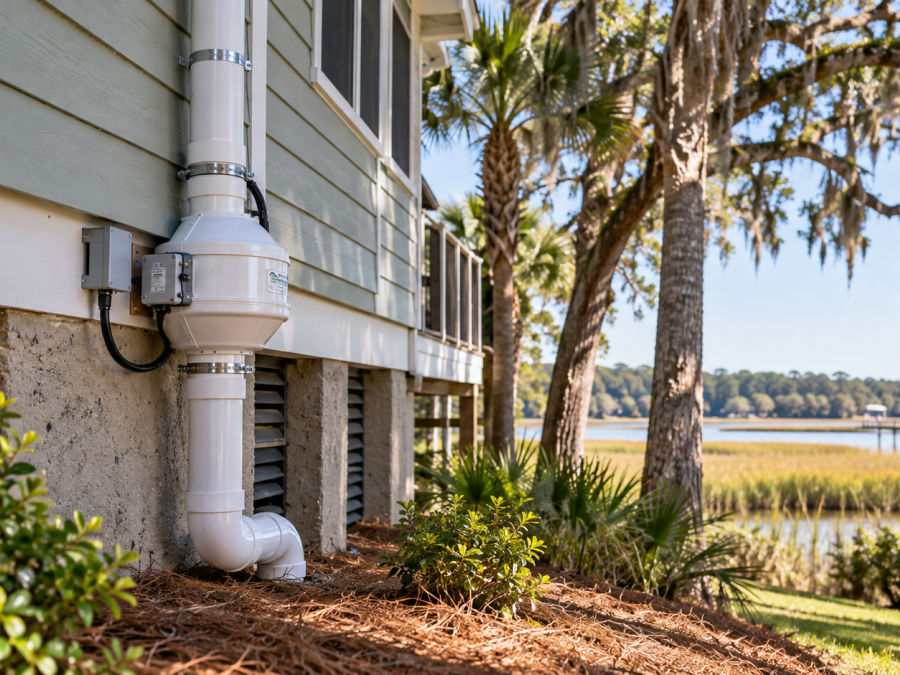
- Foundations. Plenty of Lowcountry homes sit on a slab, over a crawl space or up on piers because of flood zones. The foundation shapes how a radon system goes in, so ask for one designed for your house.
- Storms. A wind loss is a question for your homeowners policy. A flood loss is usually a question for a separate flood policy. If a storm damages a mitigation system, which one responds depends on the cause, so it is worth asking your agent in advance, not after the claim.
- Second homes. Many local homes are second homes or rentals that sit closed up for part of the year. A test measures the house as it is while the kit runs, so test with the windows and exterior doors shut, the way the kit directions say.
What your policy still does
Even when it won’t pay for the fix, the policy has a part to play afterward. Once installed, a mitigation system is a permanent fixture, so dwelling coverage generally protects it from covered perils like wind or fire, subject to your deductible. Ask your agent to confirm that for your form. A fan that wears out is a maintenance item, not a claim. And before any work starts, ask the radon company for a certificate of insurance, so you know what covers a mistake on their side.
Other ways to pay
When insurance is off the table, these are the usual options:
- The seller. In a purchase, a radon contingency lets you ask for a credit, a seller-paid fix or a price change if the result comes back at 4.0 or higher.
- Renovation loans. Some programs, including FHA 203(k) and Fannie Mae HomeStyle, can finance radon work as part of a repair package. Ask your lender.
- HSA or FSA funds. This depends on your plan, so ask the administrator before you spend.
- A home warranty. These usually exclude radon, so read the exclusions before counting on one.
- A free test. South Carolina’s environmental agency has offered free radon test kits during National Radon Action Month in January. On the Clemson podcast, researcher Nicole Martinez says a second kit is free if the first comes back above the action level, and that a store-bought kit runs about $15. Check availability first, because offers change.
On cost, Pennsylvania’s environmental agency puts most installs at $800 to $1,200. Your price will depend on your foundation and the house, so get more than one written quote.
Questions to ask before you spend anything
Before you call a contractor, ask your agent whether your form carries a pollution exclusion and whether it reaches radon, whether any endorsement addresses it, and how an installed system is treated after a covered storm loss. Then ask the contractor to show proof of national certification, such as the NRPP or NRSB credentials Martinez names, along with proof of insurance. Get the price, scope, fan warranty and post-install test in writing.
If the first test is high, the Clemson researchers note that South Carolina’s health agency suggests considering mitigation when the average of two tests is above 4.0. A second test is cheap and worth doing before you decide.
Lauren Abrecht & Team
Hilton Head Insurance and Brokerage is an independent, locally owned agency led by owner Lauren Abrecht, with offices in Hilton Head Island and Bluffton, SC. Specializing in coastal home, flood, windstorm, auto, and business insurance, Lauren and her expert team help Lowcountry residents navigate complex policy options. They share practical advice to help homeowners protect their property and assets against coastal weather risks.